

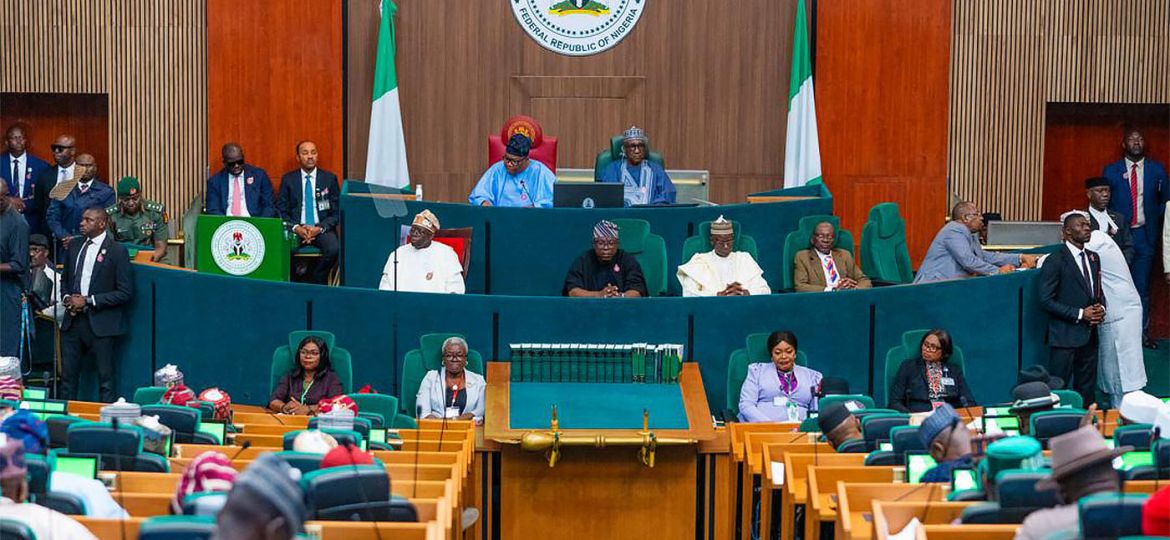
WELCOME ADDRESS BY THE PRESIDENT OF THE SENATE, HIS EXCELLENCY, DISTINGUISHED SENATOR GODSWILL OBOT AKPABIO, GCON, AT THE JOINT SITTING OF THE NATIONAL ASSEMBLY ON THE PRESENTATION OF THE 2026 APPROPRIATION BILL BY HIS EXCELLENCY, PRESIDENT BOLA AHMED TINUBU, GCFR.
Today, we assemble not merely to fulfil a constitutional requirement, but to engage in a defining national conversation—about our priorities as a people, our responsibilities as leaders, and our collective resolve to build a stronger and more just future.
Your Excellency, Senator Bola Ahmed Tinubu, GCFR, President, Commander-in-Chief of the Armed Forces of Nigeria, on behalf of the National Assembly, I warmly welcome you to this Joint Sitting. This is your political birthplace—the cradle of your public service journey and the crucible in which your leadership was tested, refined, and ultimately forged for national destiny. We equally extend our warm felicitations to our dear Vice President, who
shares the history and memory of this hallowed place, His Excellency Senator Kashim Shettima, GCON.
We also offer our warm and fraternal welcome to the Secretary to the Government of the Federation, members of the Federal Executive Council, and all members of your distinguished entourage.
Mr. President, your presence before Parliament today underscores a fundamental truth of democratic governance: that progress is forged when institutions work in concert; when authority is exercised with accountability; and when leadership listens, engages, and leads with courage and clarity of purpose.
Many in our country view the patriotic collaborative work between the National Assembly and the Executive Arm as a sell-out by the Parliament. But history is unambiguous on one enduring lesson: nations advance when the Executive and the Legislature work in concert, and they falter when the two become locked in hostility. In the United States, the era of Franklin D. Roosevelt’s New Deal stands as a classic illustration. Faced with the Great Depression, an aligned Congress partnered with the Executive to pass sweeping legislative reforms—banking regulations, social security, infrastructure investment—that stabilized the economy and reshaped American society for generations. Similarly, post-war Britain witnessed remarkable reconstruction because Parliament and the government of
Clement Attlee acted with shared purpose, creating the National Health Service and rebuilding a shattered nation. In each case, progress flowed not from unanimity of opinion, but from institutional cooperation anchored in a common national interest. It is pertinent to note that history has often distilled its lessons into simple truths. One of them is this: Great nations are not built by perfect conditions, but by leaders who make hard choices together.
By contrast, stagnation has often followed periods of executive-legislative warfare. In the later years of the Roman Republic, constant power struggles between magistrates and the Senate paralyzed governance, weakened institutions, and paved the way for collapse of the empire. More recently, repeated government shutdowns in the United States—triggered by budgetary deadlock between Congress and the Executive—have disrupted public services, shaken investor confidence, and slowed economic momentum.
Across history and continents, the pattern remains consistent: when the organs of state treat each other as adversaries, the nation pays the price; but when they act as partners under the constitution, stability deepens, reforms take root, and progress becomes possible. It is within this spirit of constitutional partnership—not rivalry or servility—that great national decisions (like budgeting) acquire meaning and momentum.
Budgets tell a story. Show me a nation’s budget, and I will tell you its priorities, its fears, and its hopes. They reveal what a nation truly values, expose what it is prepared to confront, and chart the future it seeks to build. The 2026 Appropriation Bill you are about to present is therefore far more than a compilation of figures. It should be a statement of intent—a reflection of priorities, a record of difficult choices, and a roadmap for the next phase of Nigeria’s national renewal.
Over the past year, our country has navigated a period of significant transition in the midst of challenges. Families have felt the strain of rising costs. Businesses have adjusted to a changing economic environment. Young Nigerians have asked hard and legitimate questions about opportunity, fairness, and their place in the nation’s future. Insecurity has tested our collective resolve and reminded us that peace is not a gift we inherit, but a responsibility we must constantly defend.
Yet history teaches us something enduring: Nigeria does not retreat in the face of difficulty—we confront it. We confront it with resilience forged in adversity, with faith in our shared destiny, and with an unyielding belief that tomorrow can be better than today. From one generation to the next, this nation has survived storms not by surrendering to despair, but by standing together, reforming what must be reformed, and renewing our commitment to justice, inclusivity, and progress.
This is not a season for cynicism. It is a season for optimism. Not a moment for resignation, but a call to responsibility—by government, by institutions, and by citizens alike. For every challenge before us is also an invitation: to build a more equitable economy, to secure our communities, to restore trust in public life, and to ensure that the promise of Nigeria is not postponed, but delivered.
The 2025 Budget was introduced at a moment that demanded uncommon courage. It required confronting structural weaknesses long postponed. And it is important to place on record that the progress we are now witnessing has been achieved despite persistent scepticism, relentless criticism, and the loud objections of naysayers and traducers who doubted both the necessity and the resolve of reform. These were difficult decisions—yet necessary ones—and they reflect a leadership willing to choose long-term national interest over short-term comfort.
As a result, we are now witnesses to measurable gains. Government revenues are improving. Public finance is being managed with greater discipline and transparency. Strategic investments in infrastructure, energy, agriculture, and human capital are laying a firmer foundation for sustainable growth. Nigeria is regaining confidence—within its borders and in the eyes of the international community.
Over the last one year, the Tenth Senate has recorded one of the highest levels of legislative output in its history, passing a record number of bills, including landmark legislations on security, economic reform, governance, judicial administration, electoral integrity, infrastructure development, and social protection. Some momentous outcomes of this legislative productivity are bills that have fundamentally reshaped Nigeria’s reform architecture. The Senate passed critical security-sector legislation that strengthened coordination among security agencies, enhanced intelligence-sharing, and reinforced the legal framework for combating terrorism, banditry, and transnational crimes. Far-reaching economic and fiscal reform bills provided statutory backing for subsidy rationalization, public-finance discipline, revenue mobilization, and improved accountability in the management of national resources. Landmark governance and judicial-sector legislation modernized court administration, improved access to justice, reduced procedural delays, and strengthened the independence and efficiency of key democratic institutions. Electoral and political-process reforms were enacted to deepen transparency, safeguard electoral integrity, and reinforce public confidence in democratic outcomes. In addition, transformative infrastructure, energy, and social-protection legislation laid the legal foundation for accelerated capital development, power-sector reform, housing delivery, and targeted support for vulnerable Nigerians. Collectively, these laws did not merely add to the statute books; they translated reform intent into enforceable policy, stabilized governance, and provided the legal
scaffolding upon which national recovery and long-term prosperity can be built.
Progress still has to be translated into prosperity for all. Too many Nigerians continue to struggle with the cost of living. Too many young people seek dignified employment. Too many communities remain burdened by insecurity. Whenever we lose anyone to insecurity, a Senator and a Representative lose a constituent, share in the pain of the bereaved family, and are reminded—painfully—of their duty to act.
We do not see these tragedies as mere distant statistics, but as human lives—fathers and mothers, sons and daughters—whose safety is the first duty of the Government. That is why the National Assembly remains committed to strengthening the legal and budgetary frameworks that support our security agencies, enhancing oversight to ensure accountability, and working in concert with the Executive to confront the roots of insecurity with clarity, firmness, and compassion.
Nation-building is not the work of one man or one institution. It is a collective endeavour that requires patience, sacrifice, and unity of purpose. I enjoin all Nigerians to continue to support the patriotic efforts of our President. Also assure Nigerians that we will continue to serve them with heart and might and represent them with all our strength.
Let us pause here and congratulate Your Excellency for your prompt response to the call to defend democracy in Benin Republic. You made every Nigerian and every democrat in the world proud. When freedom is threatened anywhere, freedom is at risk everywhere.
Mr. President, the path of reform is rarely comfortable, but it is the only path that leads forward. Be encouraged; the National Assembly stands ready to work with you—to strengthen what works, to refine what must change, and to ensure that every naira appropriated serves the people who earned it.
Many of us from agrarian societies know the story of the baobab tree. No single man plants it for himself, and no single generation enjoys its full shade. It is planted by those who may never sit beneath it, for it takes decades—sometimes centuries—to reach maturity. Yet it is planted all the same by patriots, because posterity will one day need shelter. The planters endure the labour; those who come after enjoy the comfort. But the village prospers because everyone agrees to protect it and water it.
That is the spirit of reform. That is the meaning—and the demand—of budgeting. It is not about the applause of today, but the shade of tomorrow; not about who laboured, but who will benefit. And it is only when leadership and institutions act together—as planters, not spectators—that the tree of national prosperity can truly grow. Let us therefore water it together, for
each of us has a role to play in its survival, its success, for the sake of posterity.
Fellow Nigerians, our national story has never been one of perfection. It has always been a story of perseverance—a people who debate passionately, dream boldly, and, when it matters most, choose progress over paralysis.
If we remain faithful to our democratic ideals, steadfast in our values, and united in purpose, then I hold an unshakable belief: the finest chapters of Nigeria’s story still lie ahead.
On behalf of the National Assembly, I once again welcome His Excellency, President Bola Ahmed Tinubu, GCFR, and respectfully invite him to present the 2026 Appropriation Bill to this Joint Sitting.
God bless the Federal Republic of Nigeria.

